



In the Hungarian town of Gödöllő, at the TRUMPF Hungary site, visitors encounter an unusual symbiosis. Where one would normally expect only the hum of high-power lasers and the cold gleam of steel, works of art made of metal and fabric are on display. In a conversation with Hungary Today, Rita Kelemen, Executive Assistant at TRUMPF Hungary Kft., and Péter Alasztics, Managing Director of Intertechnika Kft., highlighted how the collaboration between the German global market leader and an innovative Hungarian family-owned business is blurring the boundaries between industry and art.
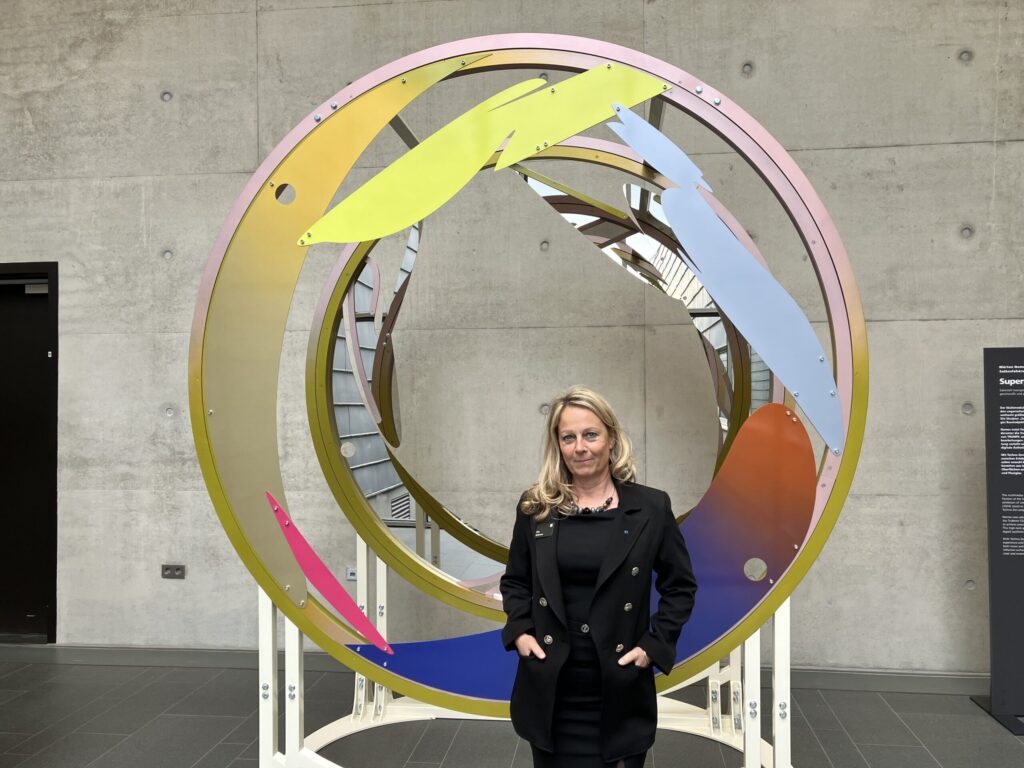
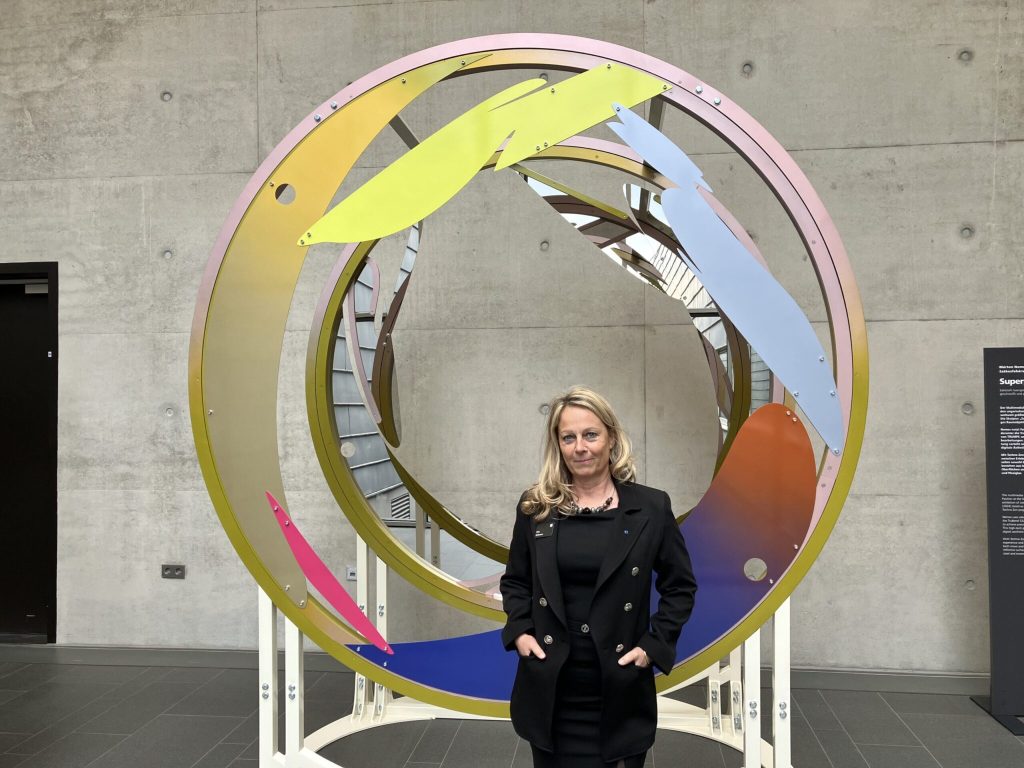
Rita Kelemen, Executive Assistant at TRUMPF Hungary Kft., with the artwork “Superposed” by Márton Nemes. (Photo: courtesy of TRUMPF Hungary and Intertechnika)
Behind this artistic collaboration are two industrial companies with clearly defined roles. TRUMPF Hungary Kft. operates from its Gödöllő location as the central sales and service hub for the Ditzingen-based global market leader. The company not only covers the Hungarian market but also serves as the representative for laser technology in the Adriatic region, offering high-tech solutions in the fields of laser cutting, bending, punching, laser welding, and laser marking. Additionally, the site functions as an important training center for software and machine operation.
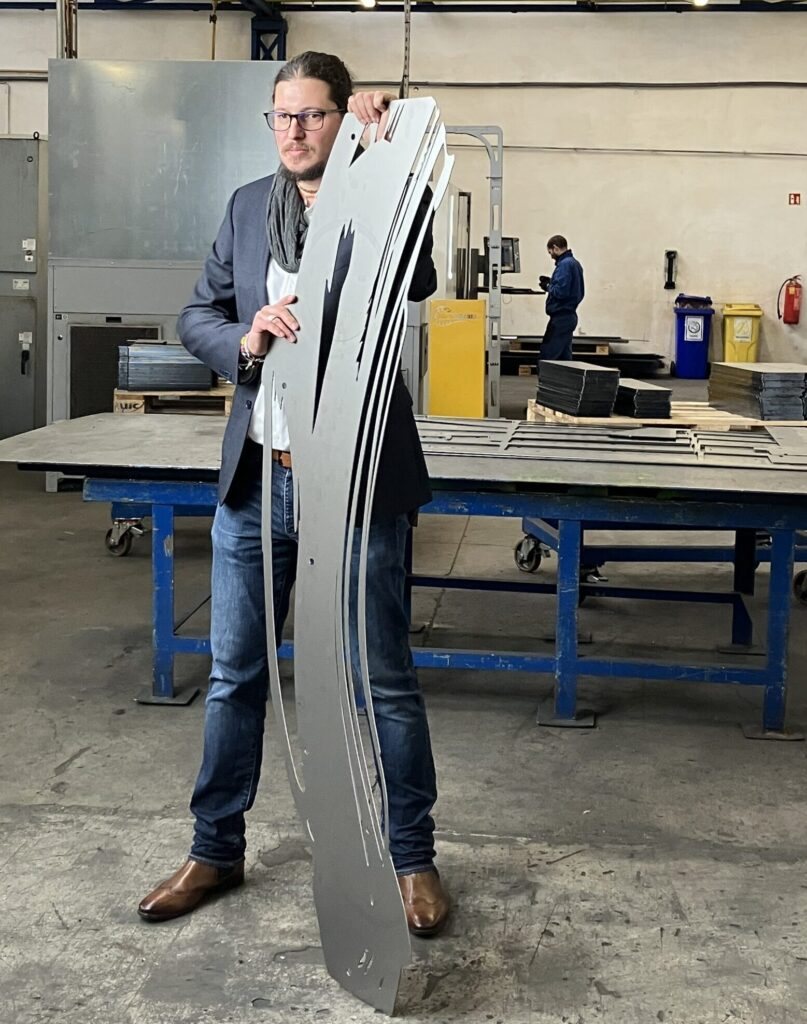
Péter Alasztics, Managing Director of Intertechnika Kft. (Photo: courtesy of TRUMPF Hungary and Intertechnika)
At the other end, there is Intertechnika Kft. from Csepel (21st district, Budapest), a mechanical engineering company founded in 1991 by the Alasztics family. With over 25 years of experience in complex sheet metal processing, the company has established itself as a highly specialized contract manufacturer. Intertechnika processes approximately 28,000 technical drawings annually and manufactures everything—from transformer parts to sophisticated enclosures—for customers ranging from small and medium-sized businesses to large international corporations.
While TRUMPF supplies the machine tools, Intertechnika contributes its manufacturing expertise to turn even the boldest designs into reality.
The foundation of this collaboration lies in TRUMPF’s corporate philosophy. At its German headquarters in Ditzingen (Baden-Württemberg, Germany), the company has long maintained a significant collection of contemporary art.
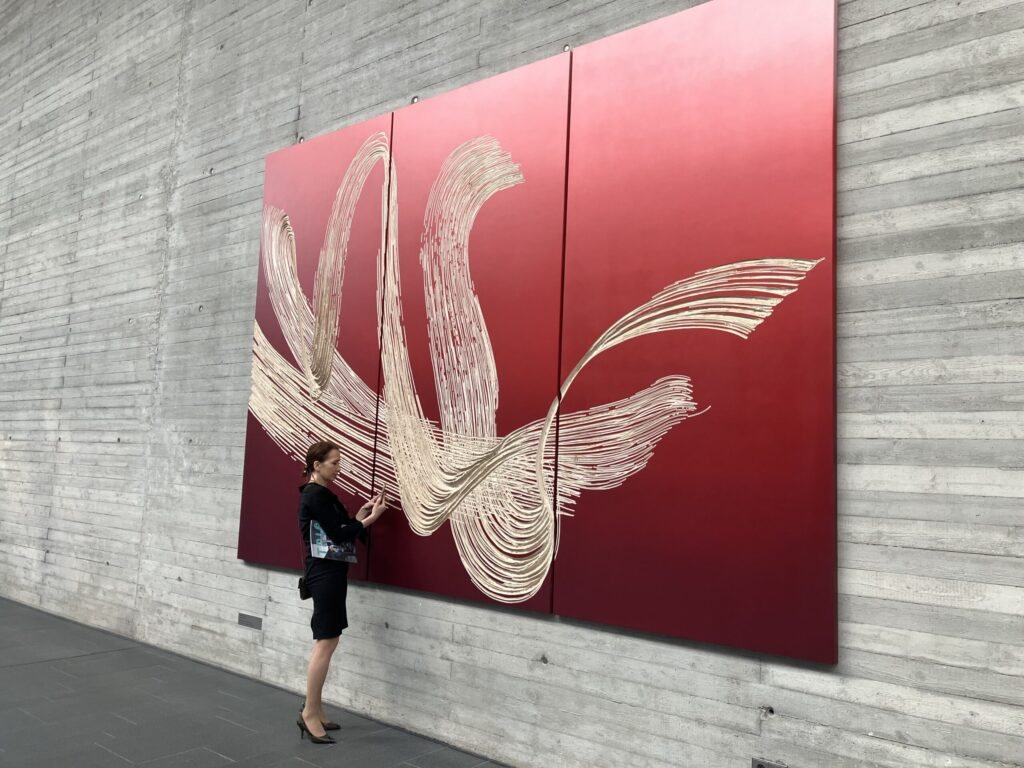
“Untitled” (fade broom) by Wolfgang Flad (lacquered and milled multiplex plywood) at TRUMPF’s German headquarters in Ditzingen (Photo: courtesy of TRUMPF Hungary and Intertechnika)
When TRUMPF Hungary established its headquarters in Gödöllő, this spirit was also intended to be carried over to Hungary—but with a strong local touch.
“We wanted our visitors to get to know Hungary through us. Local pride and art come together here, as we have decorated the building with works by local artists. TRUMPF believes that employee well-being and high-quality working conditions are the foundation for innovation,” emphasizes Rita Kelemen.
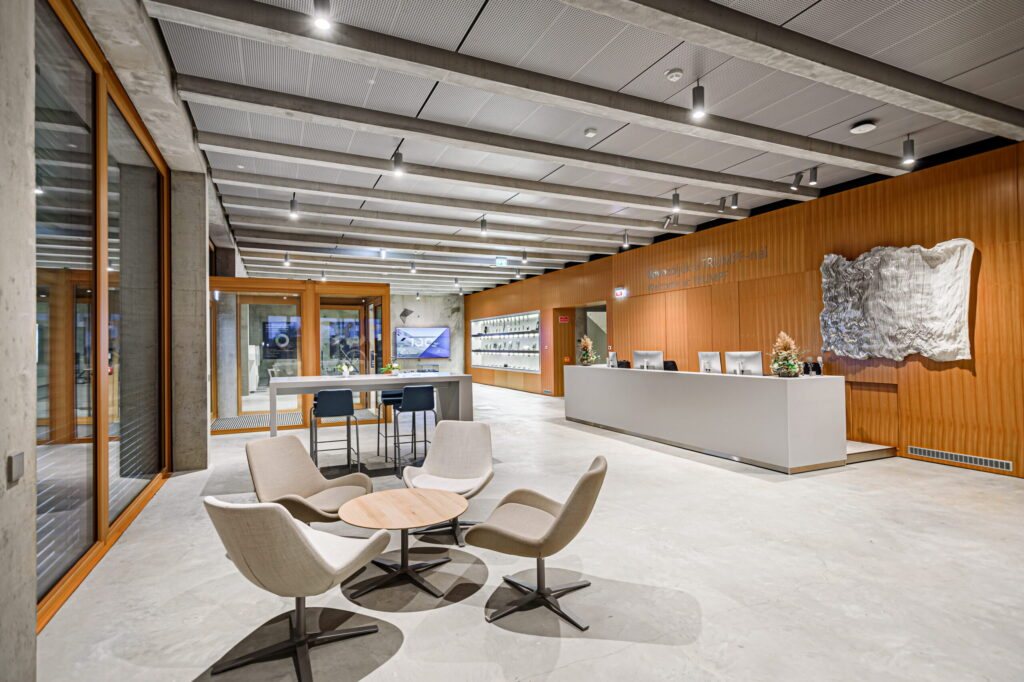
Reception area at TRUMPF Hungary Kft. in Gödöllő (Photo: courtesy of TRUMPF Hungary and Intertechnika)
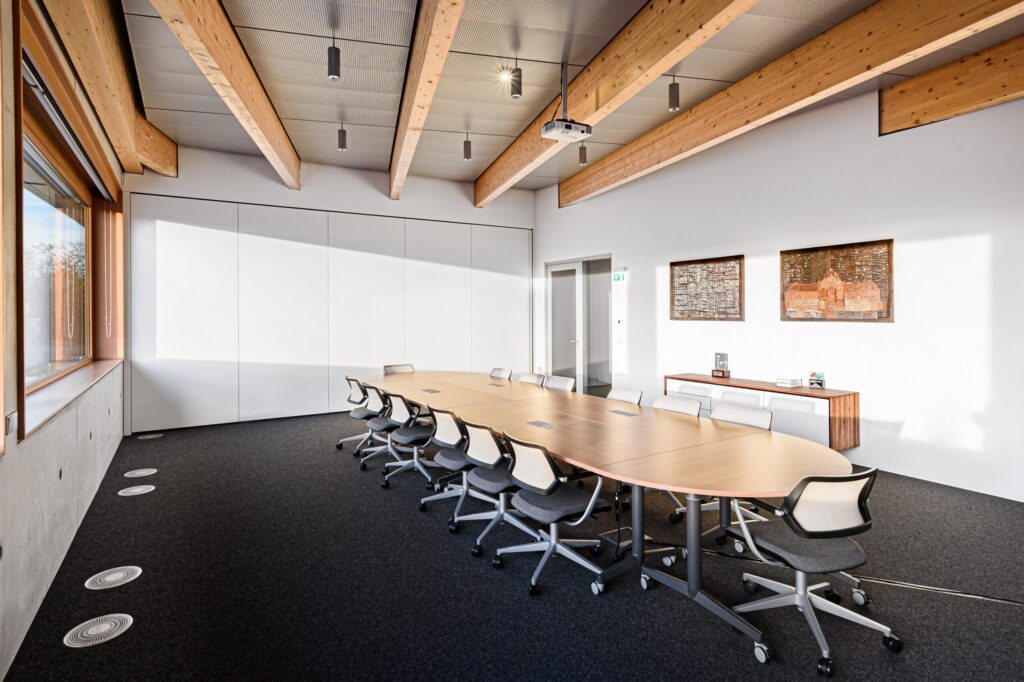
Meeting room featuring artwork at TRUMPF Hungary Kft. in Gödöllő (Photo: courtesy of TRUMPF Hungary and Intertechnika)
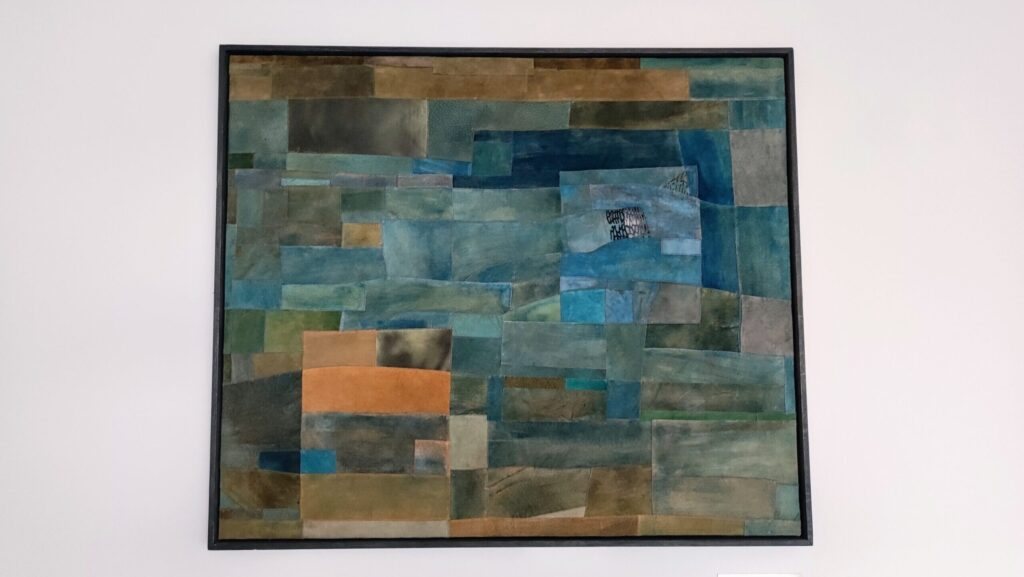
“Sea Eye” by Erzsébet Katona Szabó at TRUMPF Hungary Kft. in Gödöllő (Photo: Hungary Today)
This strategy serves not only aesthetic purposes but is also firmly rooted in the company’s culture. The well-being of employees and high-quality working conditions are, as TRUMPF sees it, the true foundation of innovation. Thus, visitors are greeted at the reception area by a textile artwork interwoven with metal—a tribute to the rich textile art tradition of the Hungarian city of Gödöllő and TRUMPF’s core competence.
The partnership with the Hungarian family-owned company Intertechnika Kft., a long-standing TRUMPF customer, has taken this vision to a new level. Last April, the collaboration culminated in the pop-up exhibition “Cut and Bent” at the Liszt Institute Stuttgart.
The exhibition featured works by renowned Hungarian artists, produced on TRUMPF machines at Intertechnika.
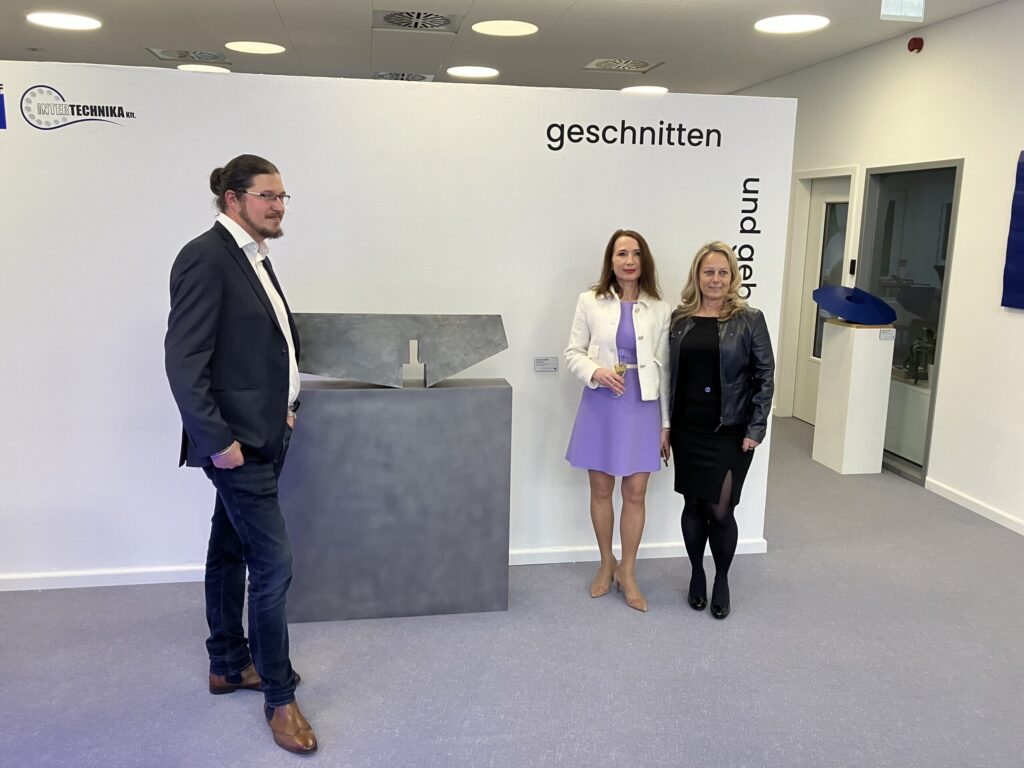
Rita Kelemen, Edit Altbäcker, responsible for project management, partnerships, and communication at the Liszt Institute Stuttgart, and Péter Alasztics (from right to left) at the opening of the pop-up exhibition “Cut and Bent” (Photo: courtesy of TRUMPF Hungary and Intertechnika)
A prominent example of this synergy is the collaboration with multimedia artist Márton Nemes. His work “Superposed,” previously on display at the entrance to the Hungarian Pavilion at the 2024 Venice Biennale, required technical finesse. At the time, the Hungarian artist was looking for a partner capable of cutting a specially coated, rainbow-colored sheet of metal.
The material is so extraordinary and expensive that only Intertechnika dared to take on the task,”
explains Péter Alasztics proudly. Today, the artist produces nearly all of his metal elements in close cooperation with the Hungarian family-owned company.
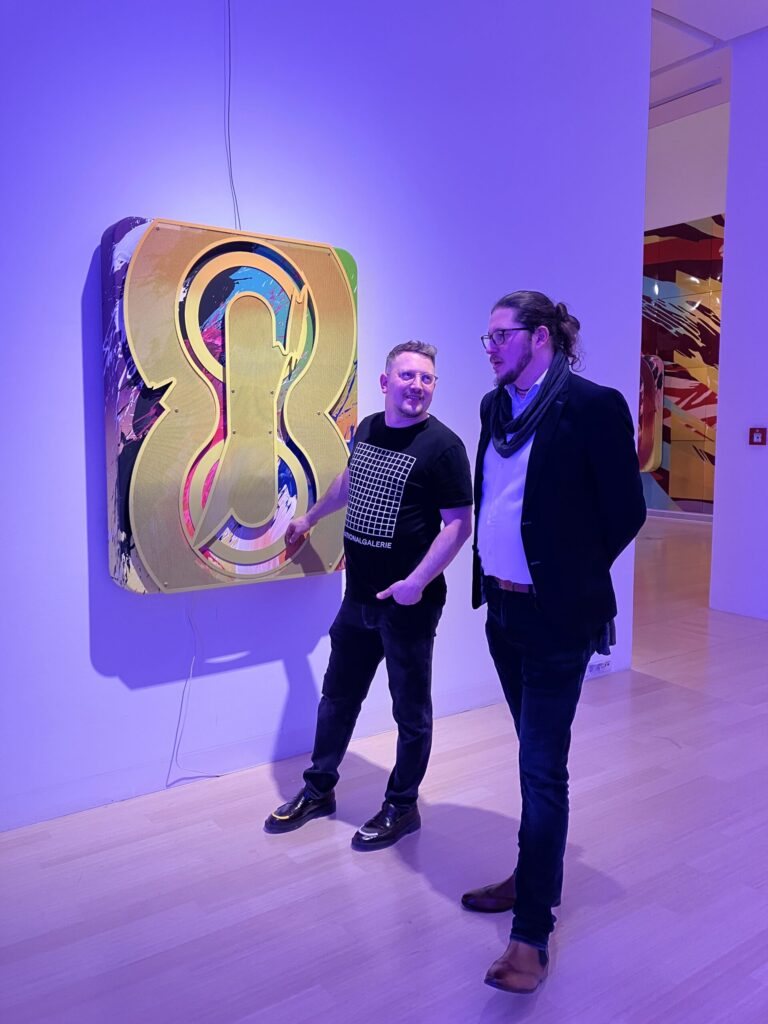
Hungarian artist Márton Nemes (left) with Péter Alasztics (Photo: courtesy of TRUMPF Hungary and Intertechnika)
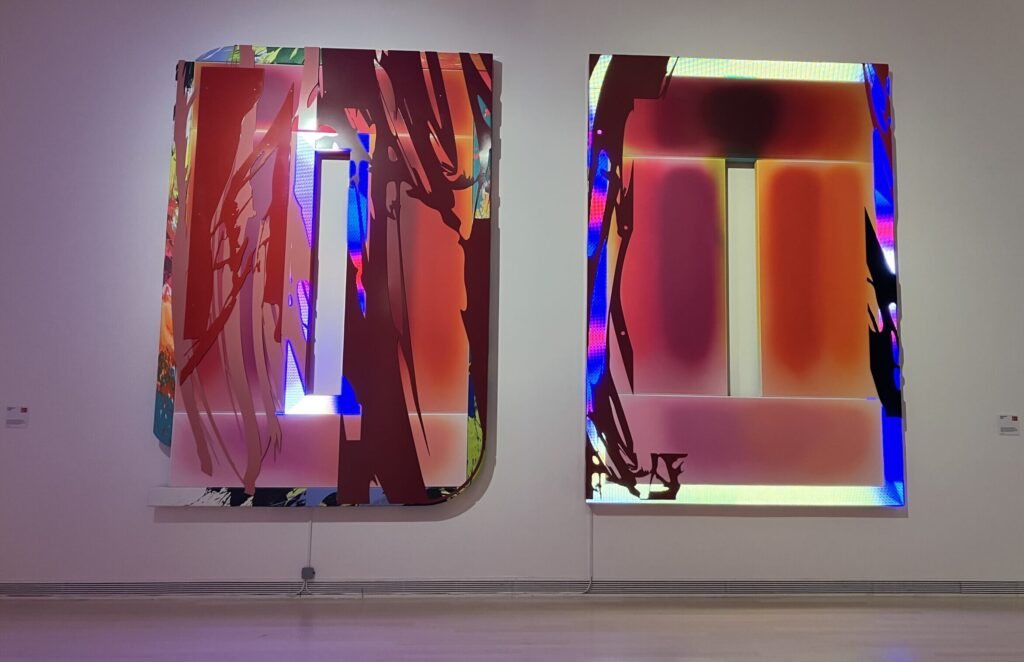
“Eclipse” by Márton Nemes (Photo: Courtesy of TRUMPF Hungary and Intertechnika)
Alasztics makes no secret of the fact that collaboration between art and industry can also lead to friction.
While engineers think in terms of millimeters and feasibility, artists are often unaware of the laws of physics.
“It is a thing with artists: they have plenty of time and do not know the laws of physics,” smiles the managing director of Intertechnika. Gravity and protractors are often their greatest enemies.
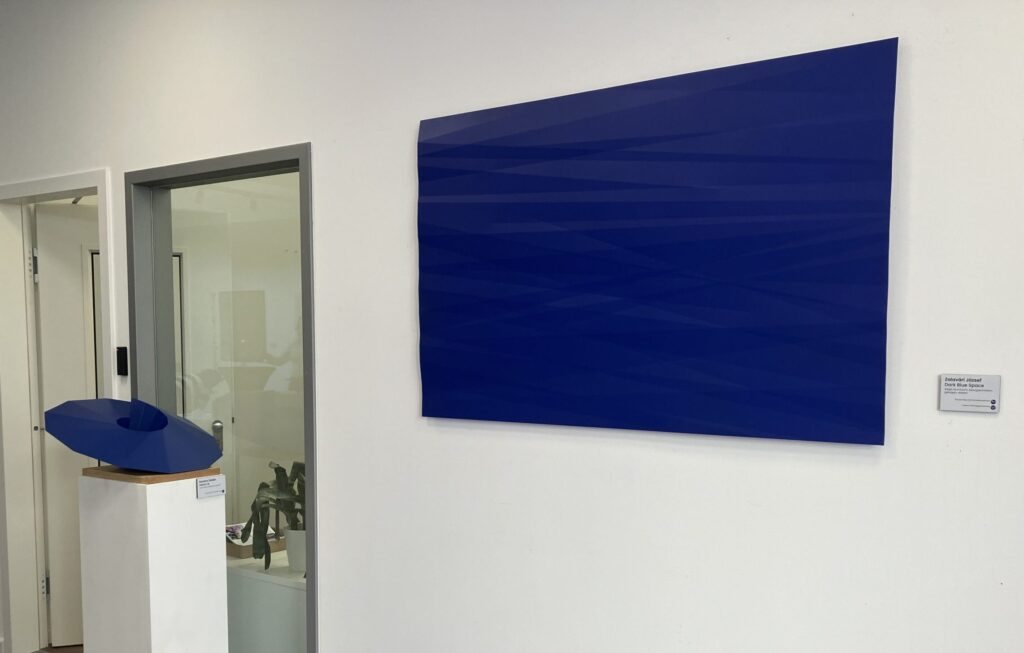
“Helica III” (steel, linden; laser-cut, bent) by Zoltán Kovács and “Dark Blue Space” (steel, powder-coated; laser-cut, bent) by József Zalavári at the pop-up exhibition “Cut and Bent” in Stuttgart (Photo: courtesy of TRUMPF Hungary and Intertechnika)
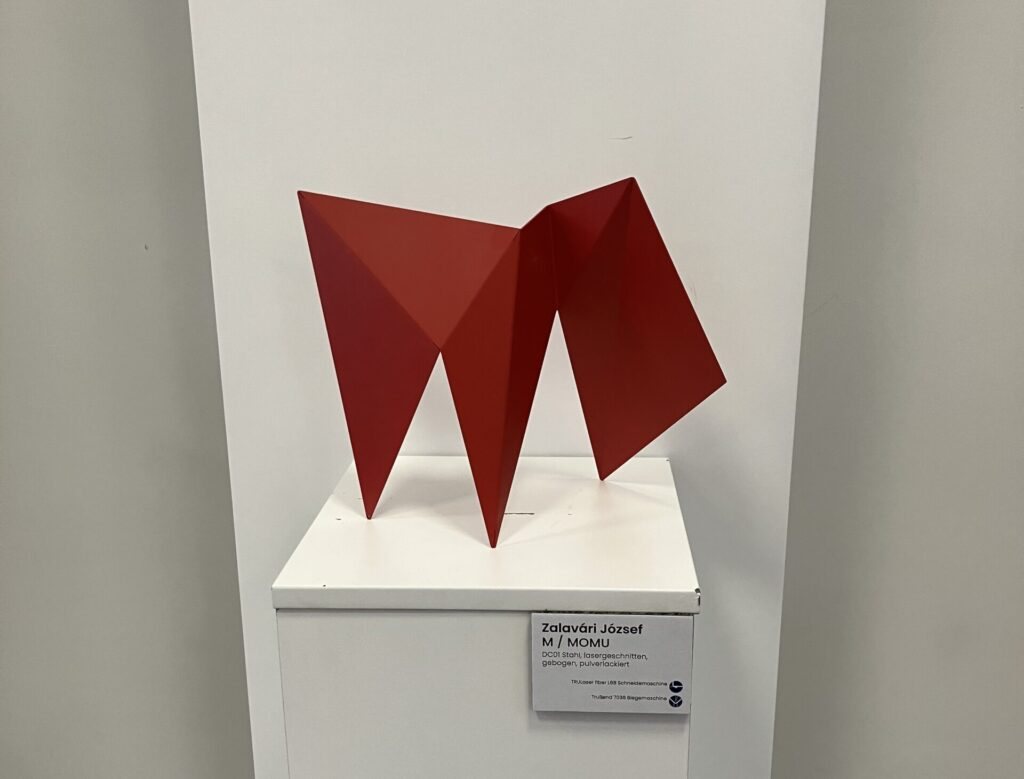
“Red M / Momu” (steel, powder-coated; laser-cut, bent) by József Zalavári at the pop-up exhibition “Cut and Bent” in Stuttgart (Photo: courtesy of TRUMPF Hungary and Intertechnika)
Yet it is precisely this conflict that sparks technical progress. While an engineer might initially reject such “impossible” ideas, the artist plants a seed of doubt in his mind. “The engineer then spends sleepless nights pondering how to make it work,” Alasztics continues.
Such challenges have led to the development of entirely new bending tools at Intertechnika, for instance, that can also be used in regular production.
In addition to the creative aspect, both companies also pursue an educational goal. In collaboration with the Hungarian University of Fine Arts (Magyar Képzőművészeti Egyetem, MKE), students complete their thesis projects at Intertechnika using TRUMPF machines. Furthermore, the aim is to raise awareness of art as a corporate asset in Hungary. While corporate art collections are standard in Baden-Württemberg, they are still the exception in Hungary.
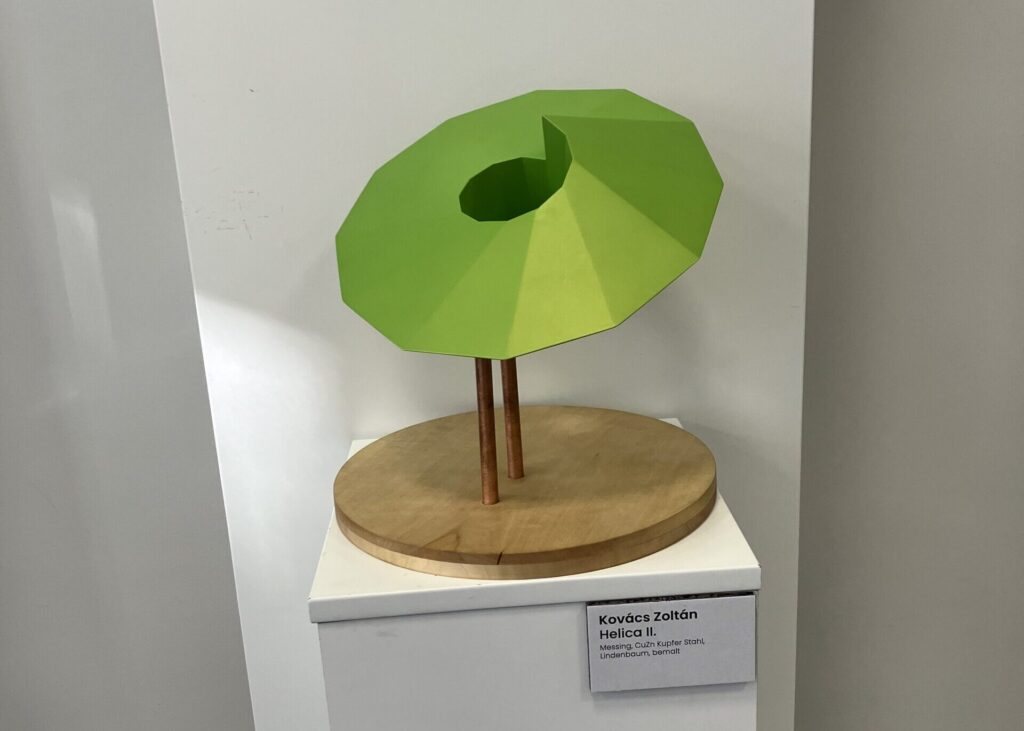
“Helica II.” (painted brass, linden wood) by Zoltán Kovács at the pop-up exhibition “Cut and Bent” in Stuttgart (Photo: courtesy of TRUMPF Hungary and Intertechnika)
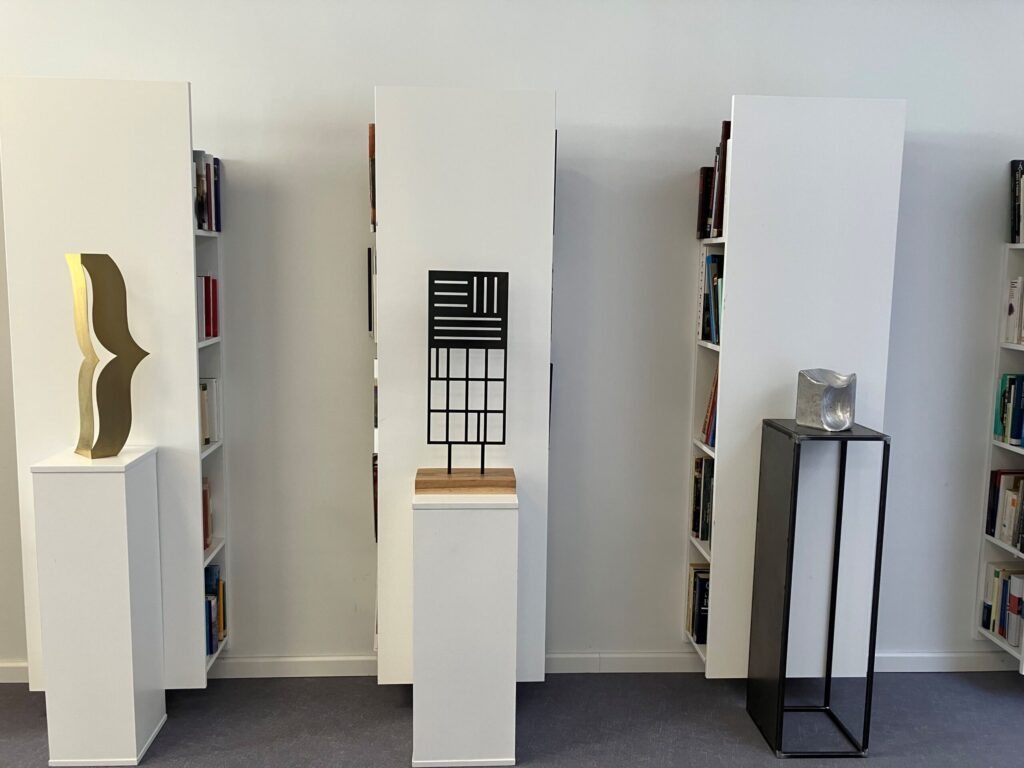
The pop-up exhibition “Cut and Bent” at the Liszt Institute in Stuttgart (Photo: courtesy of TRUMPF Hungary and Intertechnika)
An important aspect here is value retention, which Alasztics illustrates with an anecdote involving the marketing director of the parent company. The two agreed that
TRUMPF machines and artworks are essentially the same: “They are expensive, and both earn their price—the machine through production, the artwork through time, as it is an investment that retains its value.”
Plans for the coming year are already in place. Kelemen announced the introduction of a special TRUMPF award to honor loyal customers in the future. This award will be designed by Hungarian sculptor Zoltán Kovács.
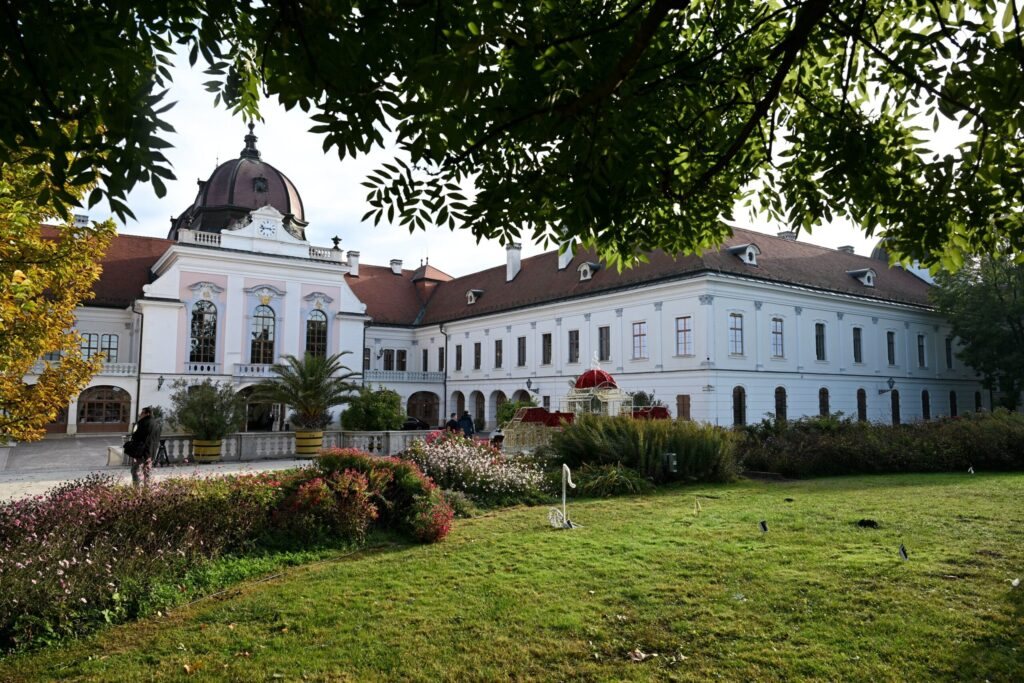
Sissi’s Palace in Gödöllő (Photo: Zoltán Máthé/MTI)
Another highlight will be the summer party of the German Business Club Hungary at Sissi’s Palace in Gödöllő.
This event, featuring an exhibition curated by Alasztics, will serve as “living proof” of the innovative cooperation concept.
The goal is to demonstrate to the attending business leaders, through a presentation, how companies can not only act as patrons, but also acquire artworks specifically as value-enhancing investments. The aim is to show that the combination of industrial manufacturing—artworks made of sheet metal, produced on TRUMPF machines—and entrepreneurial investment represents a perfectly functioning model for the modern business world.
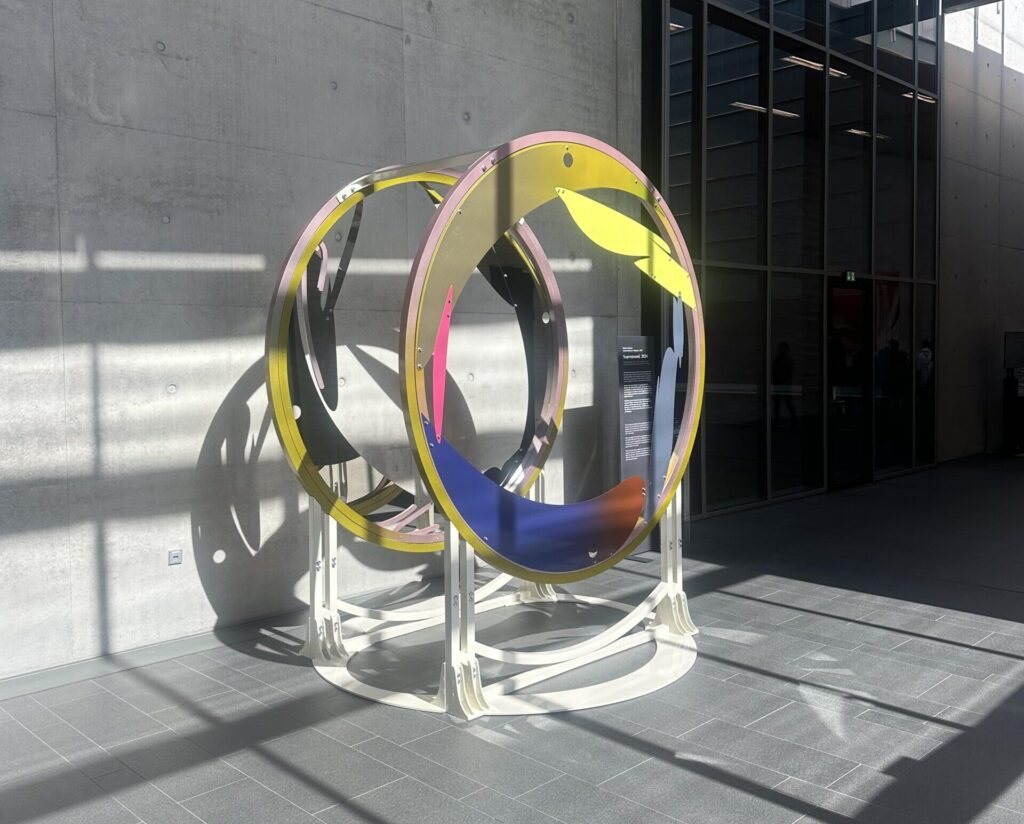
“Superposed” by Márton Nemes (Photo: courtesy of TRUMPF Hungary and Intertechnika)
At the same time, the MACH-TECH industrial trade fair will feature a reinterpretation of the TRUMPF logo by József Zalavári. For Kelemen, this cultural component has become indispensable at trade fairs. She reports receiving feedback that some visitors come to the fair solely because TRUMPF exhibits art there. “At a trade fair filled with technology and machines, there is often a lack of life, of people—and that matters a great deal,” she concludes.
Enikő Enzsöl 2026.03.25. HungaryToday.hu